How to Calculate Your Freelance Hourly Rate (Without Undervaluing Your Work)
Setting your freelance hourly rate isn’t about guessing what feels right or copying what others charge. It’s about working backward from the life you want, the business you’re running, and the value you deliver. In 2026, freelancers who price strategically earn 30–50% more in their first year than those who undercharge based on fear or competition. This guide walks you through a clear, human-friendly process to calculate a rate that covers your costs, pays you fairly, and leaves room for growth.
Why Your Hourly Rate Matters More Than You Think
Your hourly rate is the foundation of your freelance business. It determines whether you’re building a sustainable career or just trading time for pennies. Unlike salaried employees, freelancers cover their own taxes, health insurance, software, equipment, and unpaid admin time. If your rate doesn’t account for these, you’re effectively paying to work.
Many new freelancers set rates too low because they’re comparing themselves to global marketplaces or fearing rejection. But pricing isn’t just about competition—it’s about coverage. A well-calculated rate ensures you’re not just surviving, but thriving.
The Core Formula: Work Backward From Your Goals
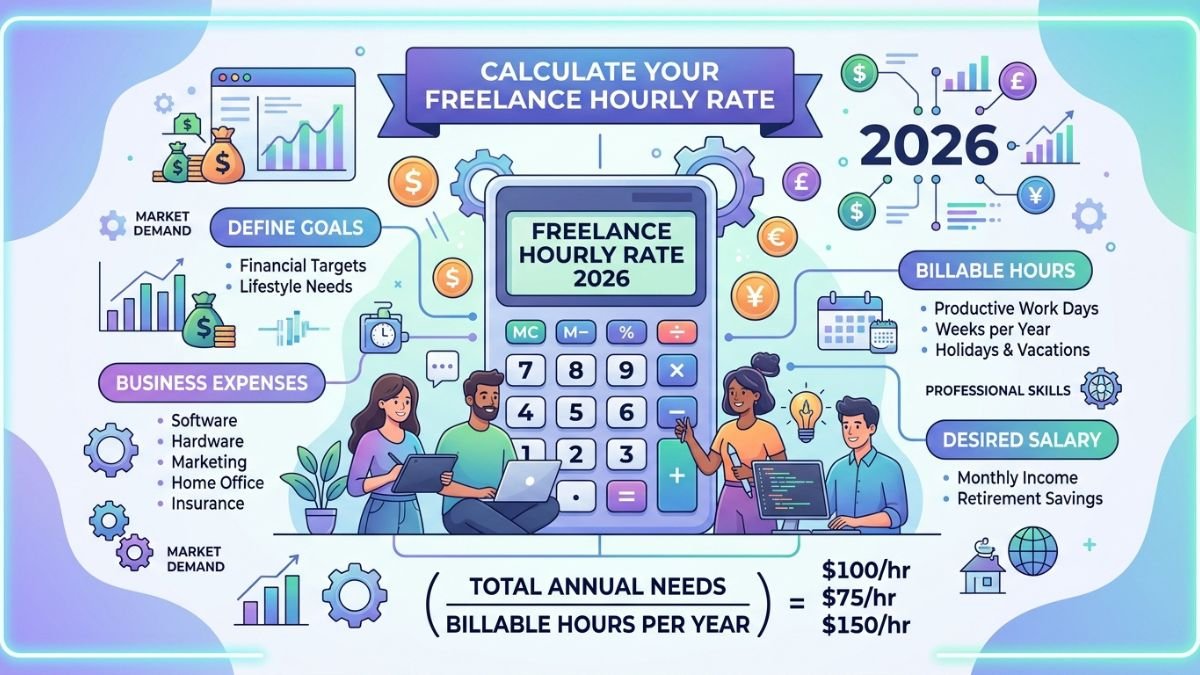
The most reliable way to set your rate is to start with your desired income and work backward. Here’s the foundational formula used by financial advisors and freelance coaches in 2026:
Hourly Rate = (Desired Annual Income + Business Expenses + Taxes + Profit Buffer) ÷ Annual Billable Hours
Let’s break that down into human terms.
Step 1: Define Your Desired Annual Income
Ask yourself: How much do I need to take home after taxes and expenses to live the life I want? This isn’t your gross revenue—it’s your net, the money that actually hits your personal bank account.
For example, if you want $60,000 a year to cover rent, savings, travel, and fun, that’s your starting number. Don’t lowball yourself here. This is your life, not a side hustle.
Step 2: Add Your Annual Business Expenses
Freelancing isn’t free. You’re running a business, and businesses have costs. Add up everything you spend to do your work:
- Software subscriptions (design tools, project management, AI assistants)
- Hardware (laptop, monitor, peripherals)
- Internet and phone
- Coworking space or home office setup
- Professional services (accountant, lawyer, courses)
- Marketing and advertising
- Insurance (health, liability, equipment)
Let’s say that totals $8,000 a year. That gets added to your desired income.
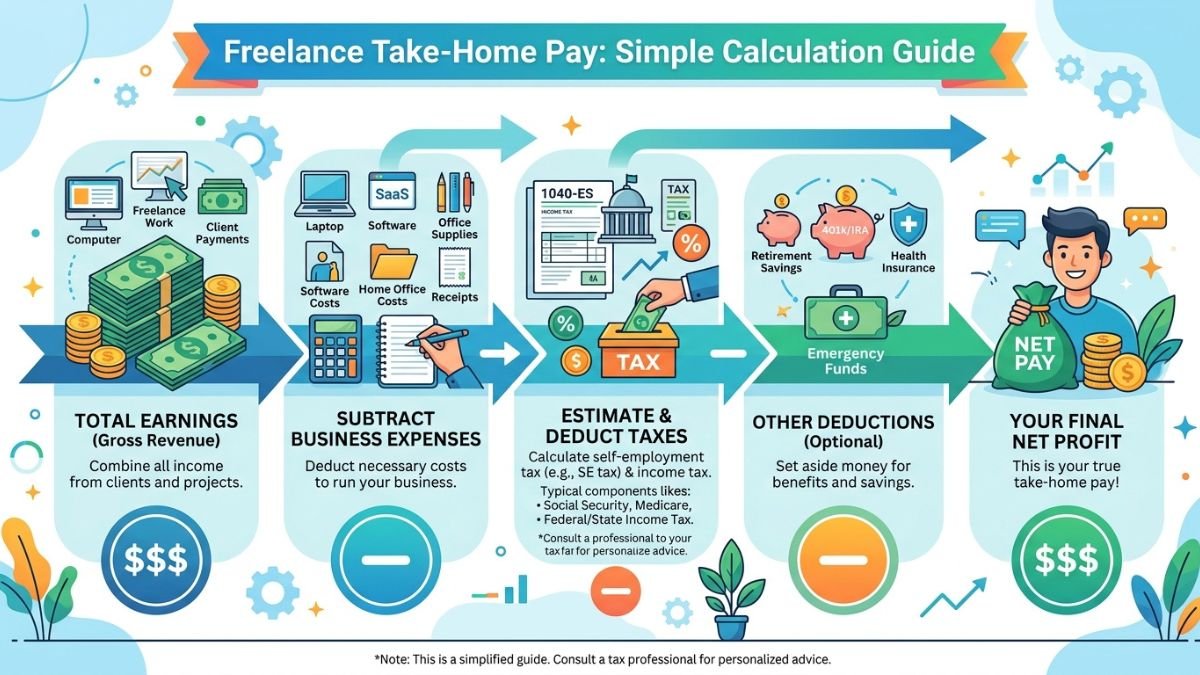
Step 3: Gross Up for Taxes
Freelancers pay both income tax and self-employment tax (Social Security and Medicare in the U.S., or equivalent elsewhere). In 2026, U.S. freelancers typically face a combined effective tax rate of 25–35%, depending on income level and location.
To find out how much you need to earn before taxes, use this formula:
Gross Revenue Needed = (Desired Net Income + Expenses) ÷ (1 − Tax Rate)
If your tax rate is 30%, and you need $68,000 ($60k income + $8k expenses), you’d calculate:
$68,000 ÷ (1 − 0.30) = $68,000 ÷ 0.70 = $97,143
That’s your pre-tax revenue target.
Step 4: Add a Vacancy or Buffer Percentage
Not every week will be fully booked. Clients delay projects, you take vacation, you spend time pitching or learning. Most freelancers realistically bill 50–70% of their total working hours.
Add a 15–20% buffer to your revenue target to cover unpaid time:
Adjusted Revenue = Gross Revenue Needed ÷ (1 − Buffer Rate)
Using a 20% buffer:
$97,143 ÷ (1 − 0.20) = $97,143 ÷ 0.80 = $121,429
This is the total revenue you need to generate annually.
Step 5: Calculate Your Annual Billable Hours
Now, figure out how many hours you can actually bill clients. A common mistake is assuming 40 hours a week, 52 weeks a year. That’s 2,080 hours—but no freelancer bills that much.
A realistic full-time freelancer might bill:
- 25–30 hours per week (after admin, marketing, learning)
- 46 weeks per year (allowing for 4 weeks vacation, sick days, holidays)
That’s 25 × 46 = 1,150 billable hours per year.
Step 6: Do the Final Division
Now plug everything into the main formula:
Hourly Rate = Adjusted Revenue ÷ Annual Billable Hours
$121,429 ÷ 1,150 = $105.59 per hour
That’s your minimum sustainable hourly rate. Round up to $110 or $120 for simplicity and positioning.
Pricing Models: Hourly vs. Project vs. Value-Based
While hourly pricing is predictable and easy to explain, it’s not always the best model for maximizing income. In 2026, top freelancers mix pricing models based on the work and client.
Hourly Pricing
Best for: Ongoing support, undefined scopes, new clients, administrative tasks.
Pros: Simple, transparent, protects you from scope creep.
Cons: Caps your income, penalizes efficiency, ties earnings to time instead of value.
Project-Based Pricing
Best for: Defined deliverables, repeatable services, clients who prefer fixed budgets.
How to calculate: Estimate hours × your hourly rate, then add 20–30% for scope buffer and profit.
Example: A website project estimated at 40 hours × $110/hour = $4,400. Add 25% buffer = $5,500 project fee.
Pros: Rewards efficiency, easier for clients to budget, scalable.
Cons: Risk of underestimating, requires clear scope definition.
Value-Based Pricing
Best for: Strategic work with measurable business impact (revenue growth, cost savings, conversions).
How it works: Price as a fraction of the value you create. If your work generates $100,000 in additional revenue for a client, charging $15,000–$25,000 is reasonable and feels like a steal to them.
Pros: Highest earning potential, aligns your success with the client’s, positions you as a partner.
Cons: Requires deep client understanding, harder to sell initially, needs confidence.
Real-World Example: From Guesswork to Confidence
Meet Aisha, a freelance content strategist in Lahore. She wanted $50,000 take-home pay, had $6,000 in annual expenses, faced a 28% effective tax rate, and planned to bill 1,100 hours per year with a 15% vacancy buffer.
Her calculation:
- Net + Expenses = $56,000
- Grossed up for taxes: $56,000 ÷ 0.72 = $77,778
- Adjusted for buffer: $77,778 ÷ 0.85 = $91,504
- Hourly rate: $91,504 ÷ 1,100 = $83.19 → rounded to $85/hour
Before this, she was charging $40/hour and burning out. After recalculating, she raised her rate, switched high-impact clients to project pricing, and increased her income by 60% within six months.
Common Mistakes to Avoid
Even with the right formula, freelancers sabotage their pricing with these errors:
- Comparing to global marketplaces: Platforms like Fiverr or Upwork race to the bottom. Your rate should reflect your market, skills, and costs—not the lowest global bidder.
- Ignoring unpaid work: Admin, pitching, learning, and client communication eat 30–50% of your week. If you don’t buffer for this, you’re undercharging.
- Not raising rates annually: Inflation, skill growth, and demand justify yearly increases. Top freelancers raise rates 10–20% per year or per new client.
- Apologizing for your rate: Confidence is part of the package. If you believe in your value, clients will too.
Tools and Calculators to Simplify the Math
You don’t have to do this manually. Several free 2026 freelance rate calculators automate the formula:
- TallyCrunch Freelance Rate Calculator – Inputs: income goal, expenses, tax rate, billable hours. Outputs: hourly, day, and weekly rates.
- AmericaCalculator Freelance Rate Tool – Includes U.S. self-employment tax defaults and vacancy buffers.
- Calcforu Hourly Rate Calculator – Geared toward EU freelancers with social contribution estimates.
Use these to validate your numbers, but always customize for your reality.
When to Charge More Than Your Calculated Rate
Your calculated rate is your floor, not your ceiling. Charge more when:
- You have specialized skills or niche expertise.
- Demand exceeds your availability.
- The client is large, well-funded, or urgent.
- The work delivers high business value (use value-based pricing).
Don’t leave money on the table because you feel guilty. Clients expect to pay for quality, and undercharging signals inexperience.
Final Thought: Your Rate Is a Living Number
Your freelance hourly rate isn’t set in stone. Revisit it every 6–12 months as your skills, costs, and market position evolve. Track your time, review your income, and adjust confidently. Pricing well isn’t greedy—it’s how you build a freelance career that lasts.