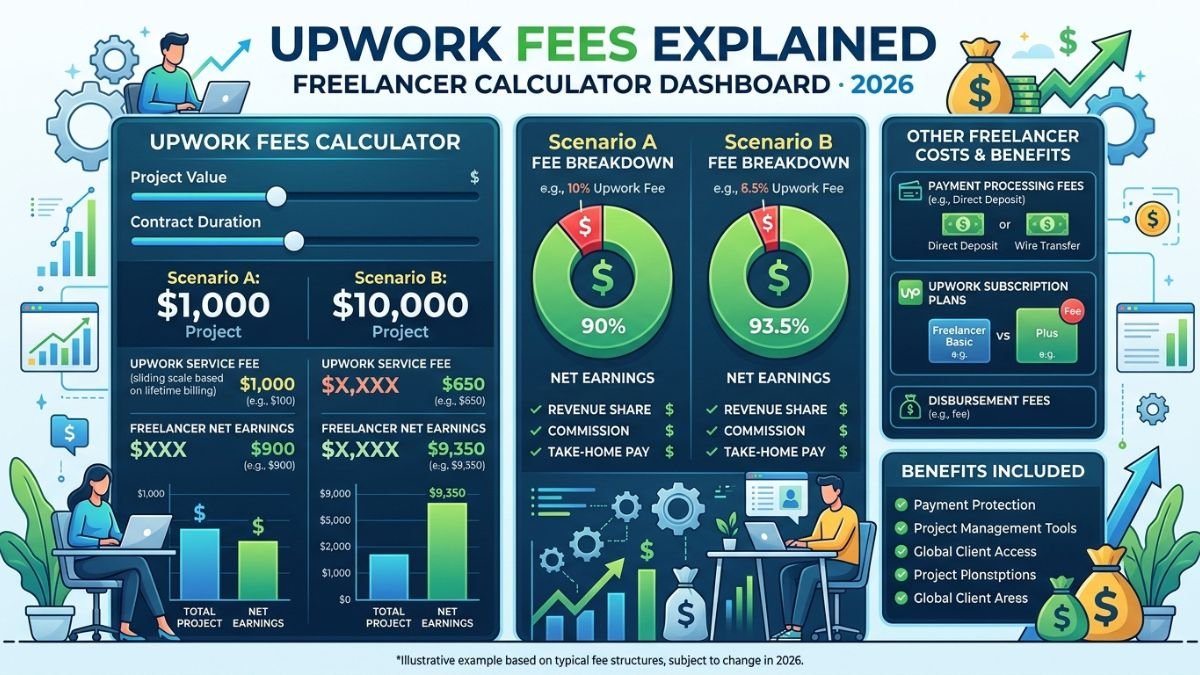
Freelance income can look impressive on paper, but the amount you invoice is rarely the amount you actually keep. Payment-processing charges, platform commissions, business expenses, taxes, insurance, and retirement savings can all reduce your final earnings.
That is why calculating your freelance take-home pay matters. It shows what is genuinely available for rent, groceries, savings, and personal spending—not just what appears in your bank account after a client pays you.
The basic formula is:
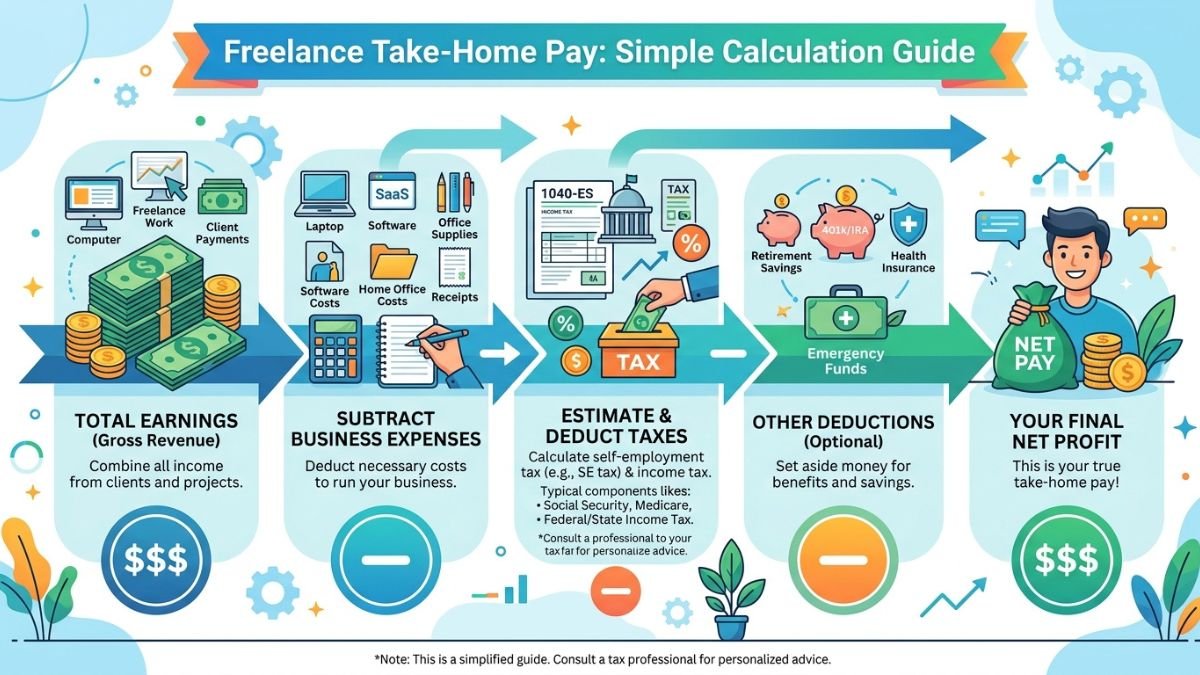
Freelance take-home pay = Gross income − business expenses − platform fees − taxes − personal financial contributions
The exact calculation depends on your country, business structure, tax bracket, and expenses. However, the process below gives you a practical way to estimate your real freelance income and set more accurate rates.
What Is Freelance Take-Home Pay?
Freelance take-home pay is the money left after you subtract the costs of earning your income and your tax obligations.
It is different from:
- Gross income: The total amount you bill or receive from clients.
- Net business profit: Your income after allowable business expenses.
- Taxable income: The amount used by tax authorities to calculate your tax bill.
- Take-home pay: The amount left after expenses, taxes, fees, and other planned deductions.
For example, suppose you invoice clients $5,000 in one month. You may need to subtract:
- $400 in software, internet, and office expenses.
- $150 in payment-processing fees.
- $1,250 reserved for taxes.
- $300 for health insurance or retirement savings.
Your personal take-home amount would be approximately $2,900—not $5,000.
This distinction helps freelancers avoid spending money that already belongs to the tax authority or is needed to cover future business costs.
The Freelance Take-Home Pay Formula
Use this formula to calculate your estimated freelance take-home pay:
[
\text{Take-home pay} = \text{Gross revenue} – \text{business expenses} – \text{platform fees} – \text{taxes} – \text{personal contributions}
]
You can also calculate your annual or monthly amount.
Monthly calculation
[
\text{Monthly take-home pay} = \text{Monthly revenue} – \text{monthly deductions}
]
Annual calculation
[
\text{Annual take-home pay} = \text{Annual revenue} – \text{annual deductions}
]
If your income changes every month, calculate your take-home pay for each payment and then review your average at the end of the quarter.
Step 1: Calculate Your Gross Freelance Income
Start with the total amount you earn before deductions. Include every source of freelance revenue, such as:
- Client invoices.
- Retainer payments.
- Royalties.
- Affiliate income related to your business.
- Digital product sales.
- Consulting or coaching fees.
- Bonuses and tips.
- Payments from freelance platforms.
Do not confuse invoiced income with collected income. An invoice may show that a client owes you $2,000, but your actual cash flow depends on when the client pays.
For a more accurate calculation, keep two figures:
- Billed income: What you have invoiced.
- Collected income: What has actually reached your account.
Collected income is usually more useful for personal budgeting. Billed income is helpful for forecasting future cash flow.
Step 2: Subtract Business Expenses
Business expenses are costs you incur to deliver your freelance services or manage your business. Common examples include:
- Laptop and computer equipment.
- Design, writing, accounting, or project-management software.
- Internet and business phone costs.
- Website hosting and domain registration.
- Advertising and marketing.
- Coworking-space fees.
- Office supplies.
- Professional training.
- Business insurance.
- Accounting and legal services.
- Bank charges.
- Travel for client work.
- Payment-processing fees.
In the United States, self-employed individuals generally calculate net profit by subtracting business expenses from business income. The Internal Revenue Service also states that self-employed people may need to pay both self-employment tax and income tax. irs
Only count expenses that are genuinely connected to your freelance work. Buying an expensive device does not automatically make the full cost a business expense. Rules may depend on how much you use the item for business and your local tax laws.
Track business and personal expenses separately
A separate business bank account makes your calculations easier. It also helps you identify spending patterns and organize receipts.
If you use one item for both business and personal purposes, record only the business portion. For example, if you use your internet connection 70% for client work, you may need to allocate the expense rather than treating the entire bill as a business cost.
Keep records of:
- The date of each purchase.
- The supplier or merchant.
- The amount paid.
- The business purpose.
- The receipt or invoice.
- The percentage used for business, when applicable.
Good records make your take-home estimate more realistic and can simplify tax preparation.
Step 3: Account for Platform and Payment Fees
Freelance platforms and payment processors may deduct fees before you receive your money.
Possible charges include:
- Marketplace commissions.
- Payment-processing fees.
- Currency-conversion charges.
- Withdrawal fees.
- Subscription costs.
- Bank-transfer fees.
- Chargeback fees.
Suppose a platform charges a 20% commission on a $1,000 project. You would receive $800 before taxes and other expenses.
Payment processors may use a percentage fee plus a fixed amount. For example, a charge of 2.9% plus $0.30 on a $1,000 payment would cost approximately $29.30. Actual rates vary by provider, country, payment method, and account type, so check the current pricing page for the service you use.
The formula is:
[
\text{Net after processing fee} = \text{Gross payment} – (\text{Gross payment} \times \text{percentage fee}) – \text{fixed fee}
]
For a $1,000 payment with a 2.9% fee and a $0.30 fixed charge:
[
$1,000 – $29 – $0.30 = $970.70
]
When setting your freelance rate, include these charges instead of treating them as an unexpected surprise.
Step 4: Estimate Your Taxes
Taxes are often the largest difference between freelance revenue and personal take-home pay.
Your tax bill may include:
- Federal or national income tax.
- State, provincial, or regional tax.
- Self-employment or social-security contributions.
- Value-added tax or sales tax collected on behalf of the government.
- Local business taxes.
Tax rules differ significantly by location. A freelancer in the United States may owe self-employment tax in addition to regular income tax. The IRS explains that self-employment tax generally covers Social Security and Medicare taxes, and that part of the tax may be deductible when calculating adjusted gross income. irs
Do not treat sales tax, VAT, or similar amounts as personal income. If a client pays $1,100, including $100 in VAT, the $100 generally belongs to the tax authority rather than to you.
Use a tax reserve
Instead of waiting until the tax deadline, move part of each payment into a separate tax savings account.
A simple process is:
- Receive the client payment.
- Subtract platform fees and immediate business costs.
- Transfer a planned percentage to your tax account.
- Use the remaining amount for business and personal needs.
- Recalculate the percentage when your income or tax situation changes.
The correct percentage depends on your location and circumstances. A general estimate may be useful for planning, but it is not a substitute for advice from a qualified tax professional.
Step 5: Include Insurance and Retirement Savings
Taxes and business expenses are not the only deductions that affect your real income. Freelancers often need to fund benefits that employees may receive through an employer.
Consider including:
- Health or medical insurance.
- Disability insurance.
- Life insurance for dependents.
- Retirement contributions.
- Paid-leave savings.
- Emergency-fund contributions.
- Professional membership fees.
These amounts may not always be deducted from your bank payment automatically, but they still reduce the money available for daily spending.
For example, if your monthly post-tax income is $4,000 and you save $500 for retirement and $250 for insurance, your practical take-home amount is $3,250.
This is an important distinction: cash remaining in your account is not always the same as money available to spend.
A Freelance Take-Home Pay Example
Imagine a freelance writer earns $6,000 in monthly revenue.
| Item | Amount |
|---|---|
| Gross client payments | $6,000 |
| Software and internet | −$250 |
| Coworking and office costs | −$200 |
| Platform and payment fees | −$300 |
| Estimated taxable business profit | $5,250 |
| Tax reserve at 25% | −$1,312.50 |
| Insurance | −$300 |
| Retirement savings | −$400 |
| Estimated personal take-home pay | $3,237.50 |
The calculation is:
[
$6,000 – $250 – $200 – $300 – $1,312.50 – $300 – $400 = $3,237.50
]
This example is only an estimate. Your actual tax bill may differ because of deductions, tax credits, filing status, location, income level, and other sources of income.
How to Calculate Your Hourly Take-Home Rate
Your freelance hourly rate should reflect more than the time you spend actively working for clients. You also spend time on:
- Marketing.
- Sales calls.
- Proposals.
- Invoicing.
- Administration.
- Revisions.
- Professional development.
- Unpaid client communication.
To calculate your effective hourly take-home rate, use:
[
\text{Effective hourly take-home rate} = \frac{\text{Annual take-home pay}}{\text{Total hours worked}}
]
Suppose your annual take-home pay is $48,000 and you work 1,600 total hours per year:
[
$48,000 \div 1,600 = $30 \text{ per hour}
]
If only 1,000 of those hours are billable, your required billable rate is higher:
[
$48,000 \div 1,000 = $48 \text{ per billable hour}
]
This is why freelancers should not set rates by comparing them only with employee salaries. Employees typically receive paid holidays, benefits, employer tax contributions, and paid administrative time.
How to Price for a Target Take-Home Pay
You can work backward when you know how much you want to keep.
Suppose you want to take home $4,000 per month and expect the following deductions:
- 25% tax reserve.
- 10% business expenses and fees.
- 10% insurance and retirement savings.
Because these deductions total approximately 45%, you would keep about 55% of your revenue.
[
\text{Required revenue} = $4,000 \div 0.55
]
You would need approximately $7,273 in monthly revenue to reach a $4,000 target take-home amount.
This approach is more practical than choosing a rate based only on competitors. It connects your pricing to your personal financial needs.
Common Mistakes Freelancers Make
Treating gross revenue as personal income
A $5,000 invoice does not mean you have $5,000 to spend. Always subtract fees, costs, and tax reserves first.
Forgetting irregular expenses
Annual software renewals, equipment replacements, insurance premiums, and professional training can create sudden financial pressure. Estimate these costs monthly, even if you pay them once a year.
Ignoring unpaid work
If you spend ten hours completing a project and five hours finding, managing, and invoicing the client, your actual hourly rate is based on all fifteen hours.
Spending tax money
Move tax reserves into a separate account as soon as you receive payment. Mixing tax money with everyday spending makes it easier to use accidentally.
Using one fixed percentage forever
Your tax position may change as your income increases. Review your estimates quarterly and update them when your business expands, your expenses change, or you begin earning in a new country.
Failing to plan for slow months
Freelance income often fluctuates. Calculate your average income across several months and build an emergency reserve during stronger periods.
A Simple Monthly Tracking System
You do not need complicated accounting software to begin. A spreadsheet can include these columns:
- Date.
- Client or platform.
- Invoice amount.
- Amount received.
- Platform fee.
- Business expense.
- Tax reserve.
- Insurance contribution.
- Retirement contribution.
- Final take-home amount.
At the end of every month, calculate:
[
\text{Total take-home} = \text{Payments received} – \text{all listed deductions}
]
Review the result against your personal budget. If the amount is lower than expected, look for changes in pricing, expenses, client mix, or payment terms.
Final Thoughts
Calculating freelance take-home pay gives you a clearer view of your business and personal finances. Start with total collected revenue, subtract legitimate business expenses and payment fees, estimate your taxes, and then account for insurance, retirement, and other financial goals.
The result is not just a number. It helps you decide what to charge, whether a project is worth accepting, how much to save, and when your freelance business needs a pricing adjustment.
Use a monthly tracking system, update your estimates regularly, and consult a local tax professional when you need advice about your specific situation. With consistent records, you can stop guessing what you earn and start managing your freelance income with confidence.