When you sell freelance services on Fiverr, the price displayed on your gig is not the amount you take home. Fiverr deducts a seller commission from every completed order, while withdrawal charges, currency conversion, taxes, software subscriptions, and other business expenses can reduce your final income further.
Understanding Fiverr fees before setting your prices can help you avoid undercharging. In this guide, you will learn how Fiverr’s seller commission works, how to calculate your real earnings, what buyers pay, and how to price your services more profitably.
How Fiverr Fees Work for Sellers
Fiverr generally keeps 20% of the total order value as its seller commission. This means sellers receive 80% of the amount paid for the order before withdrawal costs, taxes, and other expenses. The commission usually applies regardless of your seller level, order size, or service category.
For example, if a buyer pays $100 for your service:
- Order value: $100.
- Fiverr commission at 20%: $20.
- Amount credited to your Fiverr earnings: $80.
The same calculation applies to many forms of earnings on the platform, including gig orders, extras, custom offers, and tips. Fiverr’s flat commission makes the calculation relatively simple, but it also means the percentage does not automatically fall as your sales volume increases.
The basic Fiverr earnings formula
You can calculate your Fiverr earnings using this formula:
[
\text{Fiverr earnings} = \text{Total order value} \times 0.80
]
If your order is worth $250:
[
250 \times 0.80 = 200
]
You would receive $200 in your Fiverr balance before withdrawal charges, taxes, and other costs.
Fiverr Fee Calculation Examples
The easiest way to understand Fiverr fees is to see how they affect different order values.
| Order value | Fiverr’s 20% commission | Seller earnings before other costs |
|---|---|---|
| $25 | $5 | $20 |
| $50 | $10 | $40 |
| $100 | $20 | $80 |
| $250 | $50 | $200 |
| $500 | $100 | $400 |
| $1,000 | $200 | $800 |
A $1,000 order may sound impressive, but the amount available to you before other expenses is $800. If you spend $50 on software, pay $15 in withdrawal or conversion costs, and reserve money for taxes, your practical income is lower still.
This is why professional sellers calculate their net income before accepting an order rather than focusing only on the headline price.
Does Fiverr Charge Fees on Tips?
Tips may also be subject to Fiverr’s standard seller commission. If a buyer sends you a $20 tip, you may receive $16 after a 20% deduction, before any withdrawal or conversion costs.
This detail is easy to overlook because sellers often think of tips as a separate reward. However, tips are still processed through Fiverr’s payment system and should be included when you calculate your total platform fees.
For example:
- Order payment: $100.
- Tip: $20.
- Total amount: $120.
- Fiverr commission at 20%: $24.
- Seller earnings before other expenses: $96.
The same principle can apply to extras and additional payments connected to an order.
What Do Fiverr Buyers Pay?
Fiverr also charges buyers a service fee at checkout. Current pricing information indicates that buyers generally pay a 5.5% service fee, with an additional fixed charge on orders under $200. Some sources list the small-order charge as $3.50, so buyers should confirm the exact amount shown at checkout.
This buyer fee is separate from the 20% seller commission. It does not increase your Fiverr earnings or reduce the commission deducted from your order.
For example, suppose your gig price is $100:
- Your listed service price: $100.
- Fiverr seller commission: $20.
- Your earnings: $80.
- Buyer service fee: added separately at checkout.
The buyer may pay more than $100, but your earnings are still based on the $100 order value after Fiverr’s seller deduction.
Why buyer fees matter to sellers
Although buyers pay the service fee, it can influence your sales. A customer who sees a $50 gig may pay more at checkout after the service charge and taxes. If the final price feels too high, the buyer may abandon the purchase or choose a cheaper seller.
You cannot remove Fiverr’s buyer fee, but you can make your offer clearer by showing exactly what the buyer receives. Strong descriptions, transparent packages, and useful deliverables can make the total checkout price feel more reasonable.
Fiverr Withdrawal Fees
Once your earnings become available, you need to withdraw them through an available payment method. The total cost depends on your country, provider, withdrawal method, and currency.
Possible charges include:
- Fiverr withdrawal fees.
- PayPal or Payoneer fees.
- Bank-transfer charges.
- Currency-conversion fees.
- Exchange-rate markups.
- Local bank deductions.
Some reports indicate that Fiverr withdrawal costs may range from zero to a few dollars depending on the method, while the payment provider may apply separate conversion or transfer charges.
For example, assume you have $400 in Fiverr earnings. If the withdrawal method charges $3 and the currency conversion reduces the value by another $5, your final amount may be approximately $392 before taxes.
The advertised withdrawal fee is not always the complete cost. Check the amount you will actually receive in your local currency.
Fiverr Fees for Freelancers in Pakistan
Freelancers in Pakistan should pay attention to currency conversion, receiving methods, and bank deductions. Your Fiverr earnings may be displayed in U.S. dollars, while your bank account receives Pakistani rupees.
The final amount can be affected by:
- The provider’s exchange rate.
- Bank conversion charges.
- International payment fees.
- Withholding or tax deductions.
- Transfer limits or account requirements.
A payment method with no visible withdrawal fee may still use a less favorable exchange rate. Compare the final PKR amount rather than comparing only the advertised dollar charge.
Keep copies of your Fiverr earnings statements, withdrawal confirmations, and bank records. These documents can help you track income and speak with a local tax professional about your reporting responsibilities.
Taxes and Fiverr Income
Fiverr fees are not the same as taxes. The platform may deduct its commission, but you may still be responsible for reporting freelance income in your country.
Your tax obligations may depend on:
- Total annual income.
- Business structure.
- Residency.
- Type of freelance service.
- Export-of-services rules.
- Registration status.
- Eligible business expenses.
For example, a freelancer may receive $800 from a $1,000 Fiverr order after the platform commission. That $800 is not automatically tax-free. It may still need to be reported as business or freelance income, depending on local law.
Do not assume that a payment received through PayPal, Payoneer, or a bank account is outside the tax system. Maintain organized records and consult a qualified tax adviser for country-specific guidance.
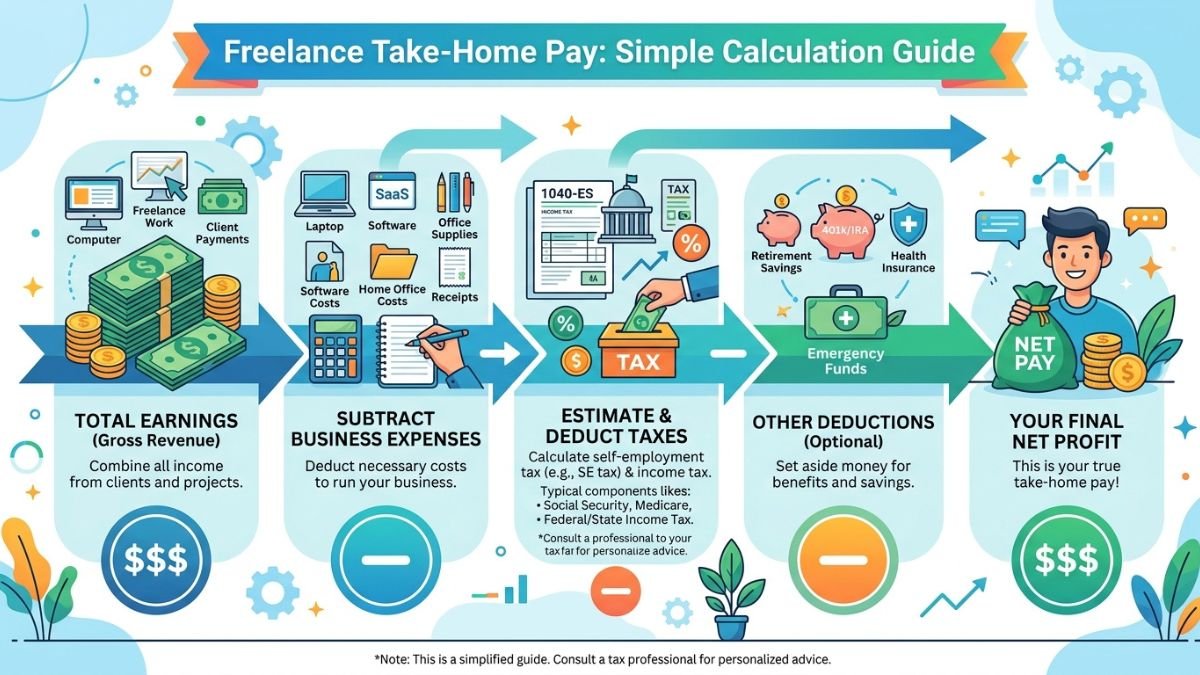
How to Calculate Your Real Take-Home Income
Your real take-home income is the amount left after every relevant deduction.
Use this formula:
[
\text{Real take-home income}
\text{Order value}
\text{Fiverr commission}
\text{Withdrawal costs}
\text{Conversion costs}
\text{Business expenses}
\text{Taxes}
]
Because Fiverr’s seller commission is typically 20%, the simplified version is:
[
\text{Real take-home income}
(\text{Order value} \times 0.80)
\text{Other costs}
]
Example: A $500 Fiverr order
Suppose you complete a $500 project.
- Gross order value: $500.
- Fiverr commission at 20%: $100.
- Fiverr earnings balance: $400.
- Withdrawal and payment charges: $8.
- Software and project costs: $25.
- Amount before taxes: $367.
Your real pre-tax income is therefore $367, not $500 and not $400.
This difference is important when deciding whether a project is worth accepting. A job that appears to pay $500 may provide a much lower effective hourly rate after delivery time and expenses.
Calculate Your Effective Hourly Rate
Your hourly rate should be based on your real income and total working time.
[
\text{Effective hourly rate}
\frac{\text{Net income}}{\text{Total hours worked}}
]
Suppose you complete a $300 order. After Fiverr’s 20% commission, you receive $240. You spend $10 on payment-related costs and work 12 hours.
[
\frac{240-10}{12}
\frac{230}{12}
\approx 19.17
]
Your effective hourly rate is approximately $19.17 before taxes.
However, do not count only the time spent creating the final deliverable. Include:
- Client messages.
- Research.
- Revisions.
- Calls.
- File preparation.
- Order management.
- Dispute or correction time.
- Time spent creating samples.
This calculation can reveal that a low-priced gig is not profitable, even if it receives frequent orders.
How to Price Your Fiverr Gigs
To protect your income, work backward from the amount you want to keep.
Use this formula:
[
\text{Required Fiverr price}
\frac{\text{Desired income}+\text{Other costs}}{0.80}
]
Suppose you want to earn $400 from a project and expect $20 in software or payment costs:
[
\frac{400+20}{0.80}
525
]
You should price the project at approximately $525 to retain about $400 after Fiverr’s 20% commission and $20 in other costs.
Hourly target example
Imagine you want to keep $30 per working hour from a 10-hour project. Your target income is:
[
30 \times 10 = 300
]
If you expect $15 in other costs:
[
\frac{300+15}{0.80}
393.75
]
A suitable project price would be approximately $394 or slightly higher.
This approach is more reliable than choosing a price based on what competitors charge. Competitor research is useful, but your price must also cover your time, operating expenses, platform fee, and profit target.
Ways to Keep More of Your Fiverr Earnings
You cannot remove Fiverr’s standard commission, but you can improve the amount you keep per hour.
Increase the value of each order
Offer packages that solve a complete problem instead of selling isolated tasks. For example, a content writer might offer keyword research, article writing, formatting, and a meta description as one package.
Use gig extras carefully
Extras can increase order value without requiring you to find a new buyer. Price them according to the additional time, expertise, and responsibility involved.
Reduce unnecessary revisions
Clearly define what is included in each package. A revision policy can prevent unlimited changes from turning a profitable order into an unpaid project.
Create efficient workflows
Templates, checklists, reusable research systems, and standard client questions can reduce delivery time while maintaining quality.
Focus on repeat clients
Repeat orders reduce the time spent writing proposals or waiting for new customers. They can also make your monthly income more predictable.
Review your prices regularly
If your calendar is consistently full, your prices may be too low. Raise prices gradually as your portfolio, reviews, and expertise grow.
Common Fiverr Fee Mistakes
One common mistake is treating 80% of the order value as final profit. That amount is only what remains after Fiverr’s commission. Withdrawal fees, software, internet costs, taxes, and currency conversion can reduce it further.
Another mistake is forgetting to include tips and extras in fee calculations. If Fiverr applies its commission to those payments, they should be included in your expected deductions.
Some sellers also set prices by copying competitors. A competitor with a different workflow, lower expenses, or more efficient delivery may be profitable at a price that does not work for you.
Finally, many freelancers calculate their rate using delivery time alone. Customer service, revisions, and administration are real working hours and should be included.
Final Takeaway
Fiverr’s standard seller commission is generally 20%, so a freelancer receives approximately 80% of the order value before withdrawals, taxes, currency conversion, and business expenses. A $100 order may leave you with $80 in Fiverr earnings, but your real take-home income can be lower.
The safest approach is to price backward from your desired net income. Track every cost, calculate your effective hourly rate, and review your prices as your skills and demand increase. When you understand the complete fee structure, Fiverr becomes easier to manage as a business rather than just a place to find individual orders.